
What is myopia?
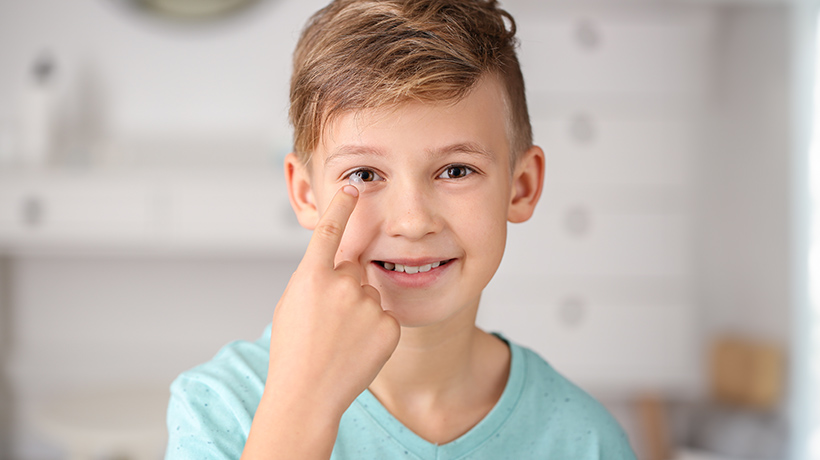
Myopia, otherwise known as nearsightedness, means distant things look blurry while close things stay clear. It happens because the eye grows too long, so light focuses just short of the retina instead of on it.
That distinction matters. Myopia isn't your child's eyes being weak, and it isn't something they'll grow out of. It's a change in the physical shape of the eye, and once it starts, it usually keeps going through the growing years.
Glasses and contact lenses correct the blur. They don't slow the growth. Myopia control is a set of treatments that do.
Why we take it seriously
A child who becomes nearsighted at seven has many more growing years ahead than one who becomes nearsighted at twelve. The younger the child, the more urgent this is.
Where they land matters for the rest of their life. Higher amounts of nearsightedness carry meaningfully higher lifetime risk of retinal detachment, myopic macular degeneration, glaucoma, and early cataract. These are conditions that threaten sight in adulthood, decades after the prescription stopped changing.
We can't undo nearsightedness. But slowing how far it progresses during childhood lowers that risk permanently. That's the entire point of myopia control: not better vision today, but a healthier eye at sixty.
Parents usually can't tell
Children rarely say their vision is blurry, because they have nothing to compare it to. What you might notice instead:
Sitting close to the TV, or holding a tablet very near their face
Squinting to see across a room or across a field
Losing interest in distance activities — not tracking a ball, not reading the board
Headaches or eye rubbing after school
A teacher mentioning attention problems that turn out to be vision problems
We measure the eye, not just the prescription
This is where our approach differs from a standard eye exam.
Using our MYAH imaging system, we measure your child's axial length which is the actual front-to-back length of the eye. Then we track it at every visit.
Prescriptions are a blunt instrument. They change in quarter-diopter steps, they shift with how tired a child is, and they can stay flat for months while the eye is quietly lengthening. Axial length tells us what's really happening, and it tells us sooner.
We plot your child's measurements against normal growth curves for their age, so you can see whether treatment is working rather than taking our word for it. If a treatment isn't holding, we know within months and we change course, instead of discovering it a year later when the prescription jumps.
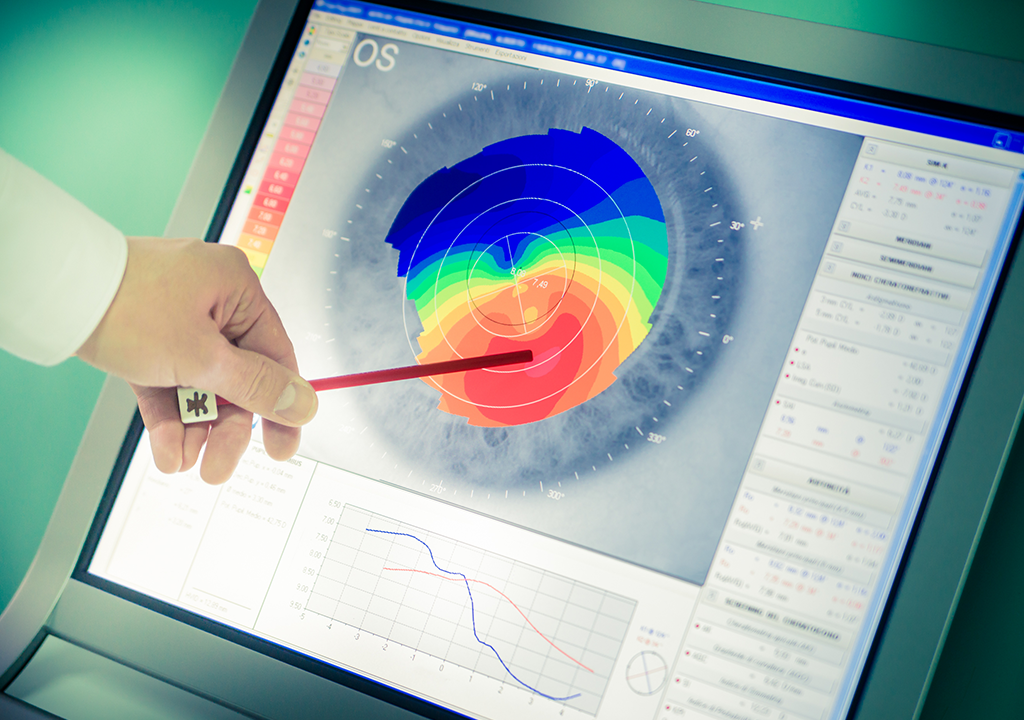
Read more about the MYAH on our Technology page.
Treatment Options
There's no single best treatment. The right one depends on your child's age, how fast their myopia is progressing, how comfortable they are with contact lenses, and what fits your
family's routine. We'll talk through it together.
Specialty eyeglass lenses
Essilor Stellest lenses look like ordinary glasses but aren't. The center gives clear vision, while a ring of tiny lenslets across the lens creates a signal that slows elongation of the eye. For families who'd rather not start with contact lenses, or for younger children, this is often where we begin.
Daily contact lenses
MiSight 1 Day is the only soft contact lens FDA-approved for myopia control in children. It's single-use, so there's no cleaning or storage, and it was designed specifically for kids. The approval study followed children for seven years. Parents often worry their child is too young for contacts. In our experience, motivated eight- and nine-year-olds handle daily lenses well, and the independence tends to be good for them. It's also a nice fit for sports, where glasses get in the way. Soft multifocal lenses work on a similar principle and can be a good option when MiSight isn't right for a particular prescription.
Other approaches
You may have read about overnight lenses (orthokeratology) or low-dose atropine drops. Both are legitimate options that we don't currently offer. If we think one of them is the better choice for your child, or if what we're using isn't holding, we'll tell you and help you find someone who provides it. Our job is your child's eyes, not keeping you in our chair.
What to Expect
Myopia control slows progression. It doesn't stop it, and it can't reverse what's already happened. Results vary between children, and some respond better than others, which is exactly why we measure.
A typical year looks like a fitting or starting visit, then follow-ups every three to six months with axial length measured each time. We'll show you the numbers at every visit and tell you honestly how it's going
Two things you can do at home that genuinely matter
Break up near work. Every 20 minutes of reading or screen time, have them look at something far away for 20 seconds. Holding a device closer than about 12 inches from the face is worth correcting when you see it.
Neither of these replaces treatment in a child whose myopia is already progressing. Both help.
Cost
Myopia control isn't one charge, and insurance treats its pieces differently. Your child's eye exam is typically covered like any annual exam. The myopia control program itself — specialty lenses, follow-up visits, and axial length measurements —
generally isn't covered as a program, because vision plans are built around correcting vision rather than slowing disease.
Partial coverage is common, though. Most plans include a contact lens or eyeglass materials allowance, and that allowance can usually be applied toward MiSight or Stellest lenses, which brings the out-of-pocket cost down. How much varies quite a bit between plans.
We'll check your benefits and give you an itemized price before you commit to anything, so you know what your plan covers, what it doesn't, and what you'll actually pay. Many families also use HSA or FSA funds. See our insurance and payment information for more.
Is your child's prescription getting stronger every year?
That's the sign worth acting on. Schedule a myopia consultation and we'll measure where your child's eyes are now, show you how that compares to where they should be, and lay out the options.

© 2026 Beachside Optometry. All rights Reserved -
Accessibility Statement
-
Privacy Policy
-
Sitemap
Managed and Designed by 