
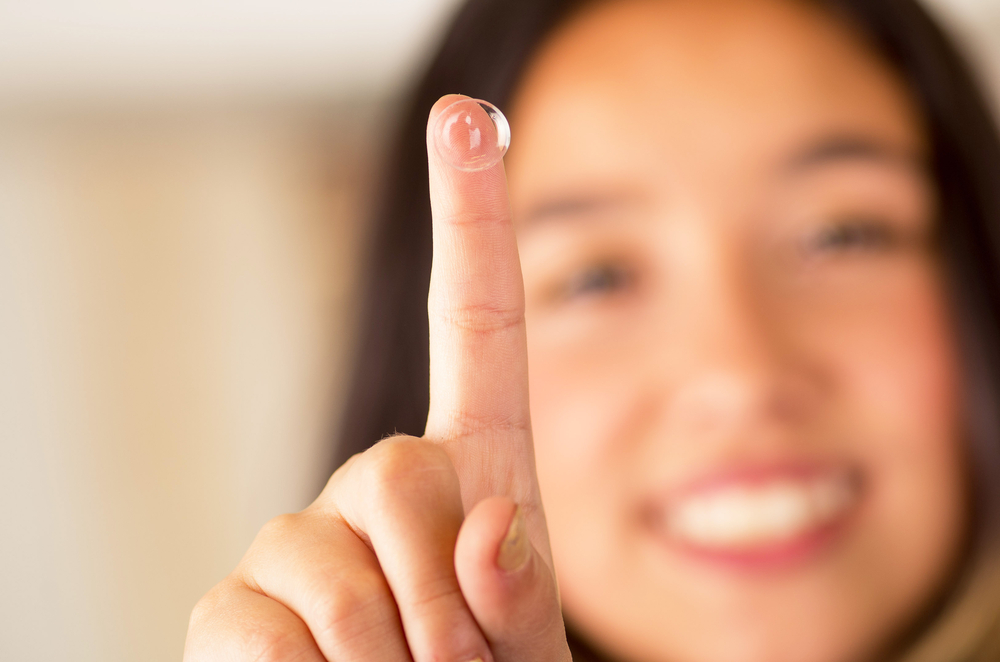
MiSight is a daily disposable soft contact lens designed to do two things at once: give yourm child clear vision and slow down how quickly their nearsightedness gets worse.
It's the first and only contact lens FDA-approved for myopia control in children. If you're new to the idea that nearsightedness can be slowed at all, start with our Myopia Control page, which covers why it matters and what the alternatives are.
How it's different from a regular contact lens
An ordinary contact lens has one job: bring distant objects into focus. It corrects the blur, but the eye keeps growing.
MiSight has concentric rings built into it. The central zone corrects your child's vision normally. The surrounding treatment zones bend some light to focus slightly in front of the retina rather than on it, which is the signal that appears to tell the eye to slow its growth.
Your child doesn't notice any of this. They put in a lens in the morning and see clearly. The
design does its work in the background.
What the research actually shows
The three-year clinical trial that led to FDA approval followed children aged 8 to 12. Compared with children wearing standard single-vision lenses, those in MiSight showed:
59% less progression in their prescription
52% less elongation of the eye
CooperVision has since published follow-up data extending to six and seven years, with the slowing effect continuing over time.
Two things are worth understanding about those numbers.
They're group averages, not a promise. Some children in the study responded better than 59%, some less. Nobody can tell you in advance which category your child will be in. And "less progression" isn't "no progression." Most children on MiSight still become somewhat more nearsighted over time. The goal is to land them meaningfully lower than where they would have finished otherwise, because where they finish is what determines their eye health as an adult.
Who it's for
MiSight is FDA-approved for children aged 8 to 12 at the start of treatment, and it corrects prescriptions from -0.25 to -6.00, with a small amount of astigmatism. It's often a good fit for a child who:
Is becoming more nearsighted year over year
Is active in sports, where glasses are a nuisance
Is motivated — this works best when the child wants it, not just the parent
Can manage a simple daily routine with a little supervision at first
Children outside that age range may still be good candidates for myopia control. The approval reflects who was in the study, not a hard cutoff for treatment. We'll talk about what makes sense for your child specifically.
"Isn't my child too young for contacts?"
This is the question we hear most, and the honest answer is: probably not.
Daily disposable lenses remove most of what makes contact lenses risky. There's no cleaning solution, no case, no lens that's been worn for two weeks. A fresh sterile lens goes in each morning and goes in the trash each night, which is why the safety record for daily disposables in children is very good.
Most eight- and nine-year-olds learn to insert and remove lenses within a visit or two. We'll teach your child directly, and we won't send them home until they can do it themselves. Many parents tell us the confidence boost is one of the better parts of the whole thing.
A few practical notes: MiSight is not for overnight wear, lenses shouldn't be worn swimming, and a spare pair of glasses is still necessary.
How we fit and follow up
Starting MiSight is more involved than a routine contact lens fit, because we're tracking a condition rather than just a prescription. At the first visit we measure your child's axial length, the actual front-to-back length of the
eye, using our MYAH imaging system. That number is our baseline, and we re-measure at every follow-up.
Prescriptions are imprecise: they change in quarter-diopter steps and shift with how tired a child is. Axial length shows us what's really happening, and it shows us sooner. We plot your child's measurements against normal growth curves for their age, so you can see whether the treatment is working instead of taking our word for it.
If it isn't working well enough, we'll tell you, and we'll talk about changing course
Read more about the MYAH on our Technology page.
Cost
Your child's exam is typically covered like any annual exam. The MiSight program — lenses, fitting, follow-up visits, and measurements — is generally not covered as a program, but most vision plans include a contact lens materials allowance that can be applied toward the lenses, which brings the cost down.
We'll check your benefits and give you an itemized price before you commit to anything. See our insurance and payment information for more.
Wondering if MiSight is right for your child?
Bring in their last two or three prescriptions if you have them. Seeing how fast things have changed tells us a lot before we've even started.

© 2026 Beachside Optometry. All rights Reserved -
Accessibility Statement
-
Privacy Policy
-
Sitemap
Managed and Designed by 